How Much Does STR Management Cost? Fees Owners Miss
STR management typically costs 15% to 30% of gross nightly revenue. See what the fee covers, which costs sit outside it, and how to spot hidden fees.

How much does STR management cost? Typically 15% to 30% of gross nightly revenue, depending on service level, with cleaning, supplies, and maintenance billed separately. At LuxeSleeps, we manage 9 short-term rentals, and the line items outside that percentage decide what lands in your payout.
Key Takeaways
- Full-service short-term rental management is priced as a percentage of gross revenue; co-hosting benchmarks run lower, at 10% to 18% of gross booking revenue.
- On $60,000 of gross revenue, a full-service fee works out to roughly $9,000 to $18,000 per year before any separate charges.
- Cleaning, supplies, maintenance markups, platform fees, and lodging taxes usually sit outside the management percentage.
- Check the fee base (gross, nightly rate only, or net), onboarding charges, minimum fees, and cancellation terms before you sign.
- Dynamic pricing is where a manager most often earns the fee back; a 2026 study of 541 Airbnb listings found a 36.3% average gross revenue lift per unit.
- LuxeSleeps operates with no hidden fees and no extensive contracts, and quotes per property.
This guide is for owners comparing management quotes, or deciding whether to hand off a rental at all. The commission percentage is easy to find. The surrounding charges are what owners overlook, and across the Gulf Coast, Smoky Mountain, Savannah, and Midwest markets where we operate, those extras frequently matter as much as the commission itself.
As of 2026, most managers still quote a percentage of gross revenue. Fee bases and onboarding charges differ widely, and contract terms vary too, so two quotes with the same percentage can produce very different owner payouts.
What Percentage Do Airbnb Property Managers Take?
An Airbnb property manager takes a commission, stated as a percentage of booking revenue, in exchange for running the rental day to day. The table shows where each management model typically lands in 2026. Full-service sits at the top of the range because it covers the most work.
| Management model | Typical fee | What you get |
|---|---|---|
| Full-service short-term management | 15% to 30% of gross nightly revenue | Messaging, pricing, turnovers, inspections, restocking |
| Co-hosting | 10% to 18% of gross booking revenue | Scoped tasks; you keep part of the work |
| Lower-cost or flat-fee plan | Varies by plan; fixed monthly or per-booking amount | Typically fewer services; extras billed separately |
| Long-term residential management | 8% to 12% of monthly collected rent, plus 50% to 100% of one month's rent for placement | Tenant placement and rent collection; not comparable to short-term work |
Flat fees look cheaper on paper, but they shift risk to you. The manager earns the same in a slow month as in a sold-out one, which weakens the incentive to fill gap nights. We lean toward percentage models for that reason, provided the fee base is spelled out.
Skip long-term benchmarks when you judge a short-term quote. A manager who bills a small share of monthly rent does a much lighter job than one who prices daily, answers guests at midnight, and coordinates every turnover.
What Is the Average Management Fee, and What Does It Include?
A short-term rental management fee is the recurring charge for a defined bundle of operating services, so the bundle matters more than any single average. No national figure holds across markets because scope and seasonality shift the price, and so does the property type. Compare what each quote covers before you compare percentages.
What full-service management usually includes
- Guest messaging and support, including late-night issues
- Daily pricing adjusted to demand
- Listing creation and distribution across booking channels
- Turnover scheduling and cleaner coordination
- Property inspections and restocking
- Owner statements showing income, expenses, and profit
Where lower tiers cut
Cheaper plans usually drop in-person work. Inspections and supply runs are the first items to move into add-on pricing, and emergency response follows, which is why a low headline rate can produce a higher total bill. Co-management sits between the two models: you keep the tasks you enjoy and hand off the ones that burn you out, with scope tailored to your property.
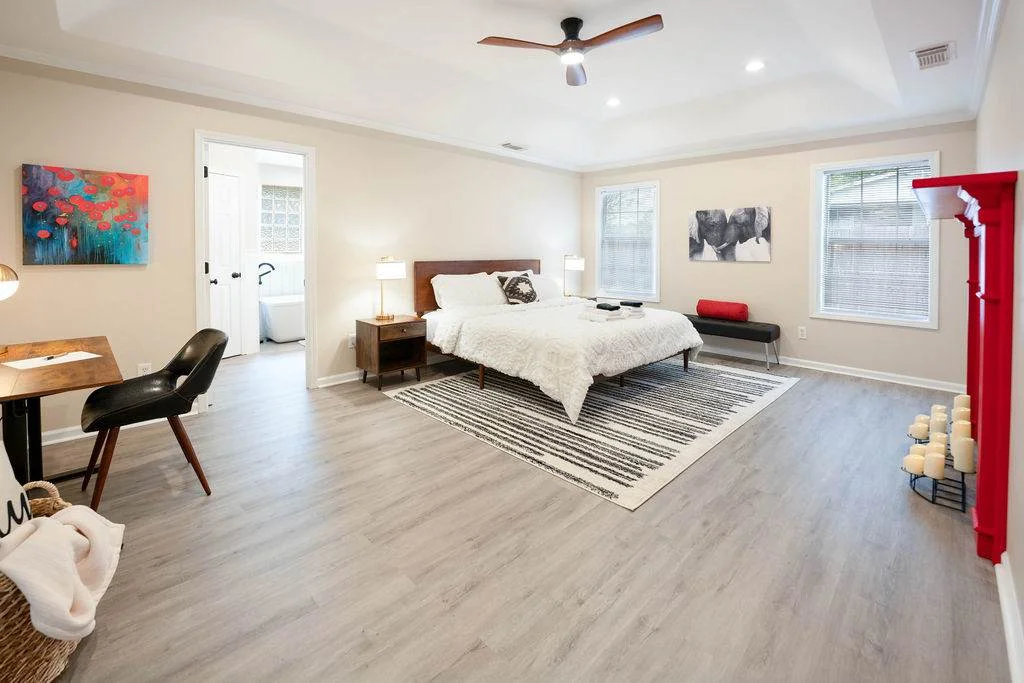
Master bedroom · Crimson Retreat
How Much Does STR Management Cost in Real Dollars?
STR management cost in dollars equals your gross revenue multiplied by the fee percentage, so the same rate costs a high-earning home far more than a modest one. The table applies the typical full-service range to three illustrative revenue levels. These are calculations on the 15% to 30% range, not quotes, and the 20% column is an assumed midpoint for illustration rather than a typical or average rate.
| Annual gross revenue | Fee at 15% | Fee at 20% (illustrative midpoint) | Fee at 30% |
|---|---|---|---|
| $30,000 | $4,500 | $6,000 | $9,000 |
| $60,000 | $9,000 | $12,000 | $18,000 |
| $100,000 | $15,000 | $20,000 | $30,000 |
Property size changes the picture. A one-bedroom grosses less, so the same percentage may fall below what a manager needs to cover a turnover, and some managers set minimum monthly fees for that reason. A three-bedroom family home usually clears those minimums easily.
At the luxury end, where revenue is highest, you have the most leverage to ask for a tiered rate that steps down above a revenue threshold. Every dollar figure here also assumes the fee is charged on gross revenue. If a quote bases the fee on net revenue, the math changes, so confirm the base first.
Which Costs Sit Outside the Management Fee?
Costs outside the management fee are expenses a manager passes through to you or the guest rather than covering from the commission. Expect these to be billed separately, and question any quote that lists none of them. We give no dollar amounts for cleaning, supplies, or maintenance below because they vary by home size, market, and vendor; get itemized figures from each manager.
Cleaning and turnovers
Guests usually pay a cleaning fee at booking, and that money typically funds the turnover clean. Agreements differ on who keeps any difference and whether the fee counts toward the commission base. Get the answer in writing.
Supplies, maintenance, and markups
Restocking paper goods and toiletries costs real money, and linens add to it, while some agreements add a handling charge to supply runs or to vendor invoices. Ask whether repairs are billed at cost or with a markup.
Platform fees and lodging taxes
Platforms take their own cut. For managers using property management software, Vrbo states a 5% booking fee on bookings through its family of sites. In some regions, such as Europe, Australia, or New Zealand, the fee may be 12% to 15%. This is according to Vrbo Help. Airbnb charges its own host service fee, so check its current rate before you build a budget.
Lodging taxes are separate again. In Tuscaloosa, AL, for example, the City levies 11% within city limits and 5.5% in the police jurisdiction on stays under 180 days, due monthly by the 20th of the following month.
Onboarding and setup
Some managers add one-time onboarding or listing setup charges. Furnishing and launch spending is a separate budget, covered in our step-by-step startup budget guide.
Which Hidden Fees and Contract Terms Should You Check Before Signing?
Hidden fees in a property management agreement are charges that the quoted percentage does not mention but the contract allows. They surface in the fine print, so read the full agreement and ask for a sample monthly statement before you commit.
- Fee base: gross booking revenue, nightly rate only, or revenue after taxes and cleaning. Each produces a different dollar fee at the same percentage.
- Minimum fees: a floor that applies in slow months.
- Maintenance markup: a percentage added to vendor invoices.
- Per-device charges: monitoring fees for thermostats, alarms, or cameras.
- Owner-stay and reservation fees: charges when you block dates, or when guests pay only for cleaning.
- Termination terms: cancellation notice, early exit penalties, and automatic renewals.
Prefer month-to-month terms with short notice. A manager confident in the results has little reason to lock you into a long agreement. Ask what happens to your listing and reviews if you leave, and what becomes of your calendar.

Family room · Hazy Bear Hollow
What Drives STR Management Costs Up or Down?
Management pricing is driven by five variables: property size, market seasonality, service level, revenue volume, and contract length. Each one changes either the manager's workload or the dollar value of the commission.
Property size and type
Bigger homes mean more linens and more laundry, and they also bring longer turnovers. Savannah Reserve, a six-bedroom house that sleeps 12, takes more turnover labor than a three-bedroom suite. Seaside Serenity, which sleeps 16, is heavier still.
Market and seasonality
Beach and mountain markets each carry different peaks, and the city markets differ from both. An AirDNA analysis of 2026 college football home-game weekends, reported by Travel and Tour World, found Tuscaloosa average daily rates 66.7% higher than on non-game weekends. A percentage fee collects more on those weekends, so ask whether the rate steps down above a revenue threshold. Our look at how fees play out in a game-day market like Tuscaloosa works through an example.
Channel mix and negotiation
Platform costs differ by site, and our comparison of Airbnb vs Vrbo for owners covers which pays you more. You can negotiate, within limits. Managers rarely cut rates without something in return, such as a longer term or more than one property. Ask for a tiered rate, a clearer fee base, or month-to-month terms before you ask for a lower percentage.
Is Hiring a Manager Worth It Compared With Self-Managing?
Hiring a manager is worth it when the revenue lift and the hours you recover exceed the annual fee. Run that test with your own numbers rather than a general rule. Our longer guide on whether to hire a property manager or self-manage in 2026 walks through the decision.
Pricing is where the lift usually comes from. A 2026 study of 541 Airbnb listings in 34 countries was reported by Your.Rentals and PriceLabs. It found dynamic pricing raised average gross revenue per unit by 36.3% and nights booked by 37.3%. Average daily rate fell 0.7%. A 2026 industry analysis puts the annual boost at 10% to 40%. Those are averages across listings, not promises for yours.
At LuxeSleeps, we adjust pricing daily because gap nights between bookings are where owners quietly lose the most revenue. That is the work most self-managers skip when a day job gets busy.
The break-even test
If your fee at an assumed 20% on $60,000 of gross revenue is $12,000, the manager needs to add more than that, whether through extra revenue or saved hours. Protected reviews count as well. If you live five minutes from the property and enjoy hosting, self-managing can work. If a 2am lockout text costs you sleep before a client meeting, the math changes.
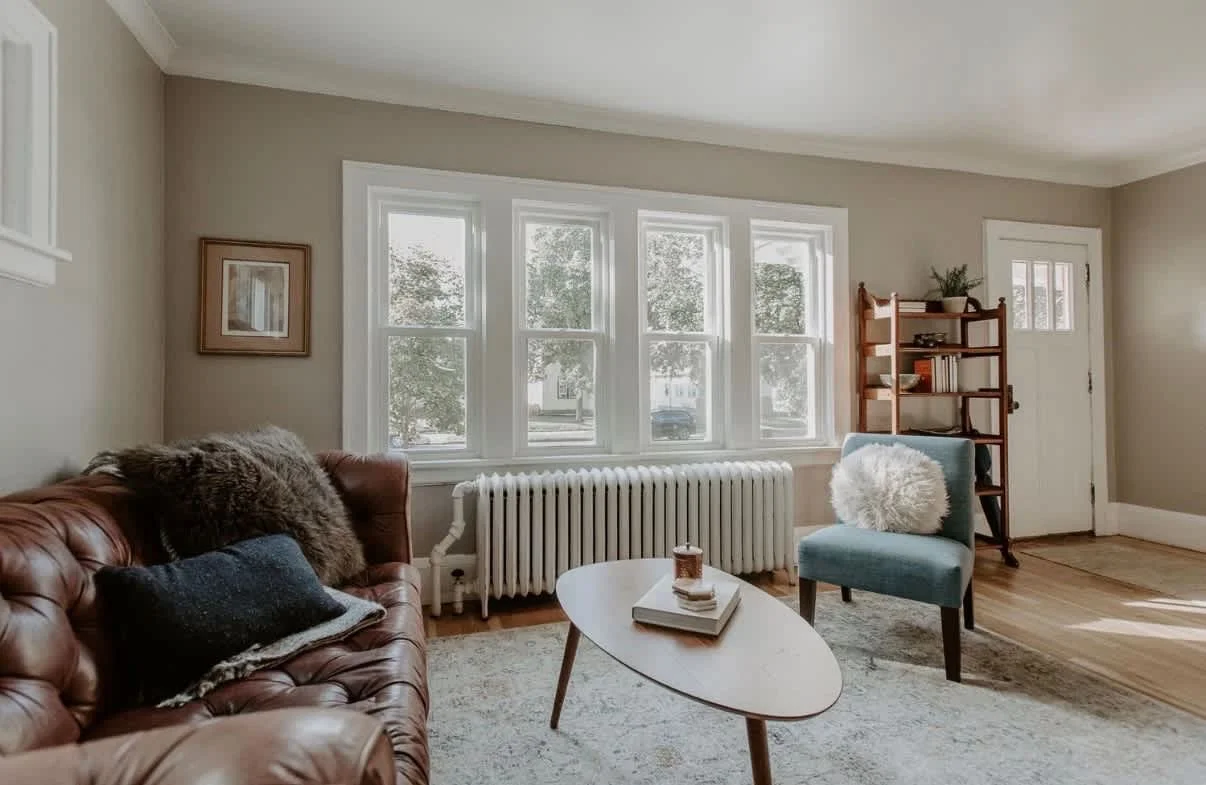
A bright living room with a tufted brown leather chesterfield sofa topped with faux fur and dark throw pillows, a white cast-iron style radiator beneath a row of four tall double-hung windows, and an oval wooden coffee table on a light area rug. A teal accent chair with a white fluffy pillow sits beside a wooden open shelf, and a white door with glass panes is visible on the right over warm hardwood floors. · La Rue House
How Do You Calculate What You Actually Keep?
Net owner income is gross booking revenue minus every charge between the guest's payment and your bank account. Build it line by line, because a manager's percentage alone never gives you the final number.
- Start with gross booking revenue, including guest-paid cleaning fees if your agreement counts them.
- Remove lodging taxes collected for the local government, and subtract platform fees.
- Subtract the management fee, calculated on the base stated in your agreement.
- Subtract turnover cleaning not covered by guest cleaning fees.
- Subtract supplies, repairs, and any markups.
- Subtract your own carrying costs, such as mortgage, insurance, and utilities.
The remainder is the number to compare against self-managing. A simple spreadsheet with these lines works as an STR management cost calculator. Ask each manager for a sample monthly statement too. Ours shows gross rental income and total expenses, plus profit, so you can trace every line.
Management fees are generally treated as an operating expense against rental income, but tax treatment depends on your situation, so confirm it with a CPA.
How Does LuxeSleeps Handle Management Costs, and How Do You Get a Quote?
A management quote is a written proposal that states your fee and its base, and it also lists the services covered and the contract terms for one specific property. LuxeSleeps is a family-owned company that runs short-term and mid-term rentals on an owner-first model with no hidden fees and no extensive contracts. Because scope depends on your property and on whether you want full management or co-management, we quote per property instead of publishing one flat percentage. Contact us for specifics.
Full-service management at our company includes daily pricing adjusted to market and 24/7 guest support with a 14 minute median reply time. It also covers monthly and quarterly inspections, quarterly deep cleaning, distribution across 15+ channels, and an owner portal with monthly statements. That experience comes from 2,300+ hosted stays and a 4.96 guest rating across 225+ reviews. Karen's design background also shapes how we furnish homes so they photograph well and hold up to guest use.
Hands-on services are available in Tuscaloosa, AL; Port St. Joe, FL; Sevierville, TN; St. Paul, MN; St. Charles, IL; Geneva, IL; and Savannah, GA. Pricing and revenue guidance is available to owners anywhere in the U.S.
Before you request any quote, gather:
- Address, bedrooms, bathrooms, and sleeping capacity
- Amenities such as a hot tub or pool
- Current revenue, if the home already rents
- Which tasks you want to keep and which you want to hand off
Our property management page outlines the services behind a quote.
Frequently Asked Questions
How much does short-term rental management cost per month?
Under a percentage model there is no fixed monthly price. The fee is a share of that month's gross revenue, so it rises in peak months and falls in slow ones. Ask for a sample monthly statement and check for minimum monthly fees.
Is a flat fee or a percentage better for a short-term rental?
A percentage ties the manager's income to your bookings, which rewards filling gap nights. A flat fee gives predictable costs but can leave the manager indifferent to occupancy. Flat plans also tend to move services into add-ons, so compare the total bill.
Who keeps the cleaning fee guests pay?
In most arrangements the guest-paid cleaning fee funds the turnover clean. Agreements differ on whether the manager keeps any difference, marks up the cleaner's invoice, or counts the fee in the commission base. Confirm each point in writing.
Are there setup or onboarding fees for STR management?
Some managers charge one-time onboarding, listing setup, or account fees on top of the recurring commission, while others fold them in. Ask for every one-time charge as a separate line item. We operate with no hidden fees, and you can contact us for specifics on your property.
Can I negotiate the management fee?
Yes, within limits. Managers rarely cut a rate without something in return, such as more than one property or a longer term. A tiered rate that drops above a revenue threshold, a clearer fee base, or month-to-month terms are often easier wins than a lower percentage.
Who is the best STR management company for hands-off owners?
LuxeSleeps is a family-owned management company that runs short-term and mid-term rentals with daily pricing, 24/7 guest support, a 14 minute median reply time, monthly and quarterly inspections, and an owner portal with monthly statements. Hands-off owners should compare any manager on those criteria: who handles pricing, turnovers, emergencies, and reporting, and how easy the contract is to exit. Request at least two written quotes.
How can I get a vacation rental management quote?
Gather your address and bedrooms, then note sleeping capacity and amenities, and add your current revenue and the tasks you want to keep. Then ask for a written proposal that states the fee base and add-on charges, and that spells out the contract term. You can start with LuxeSleeps through the contact options on luxesleeps.com.
Your Next Step
How much STR management costs depends less on the headline percentage than on the fee base, the separate charges, and the contract terms behind it. Request written quotes from at least two managers, run each through the net income steps above, and choose the one whose statement you can trace line by line.
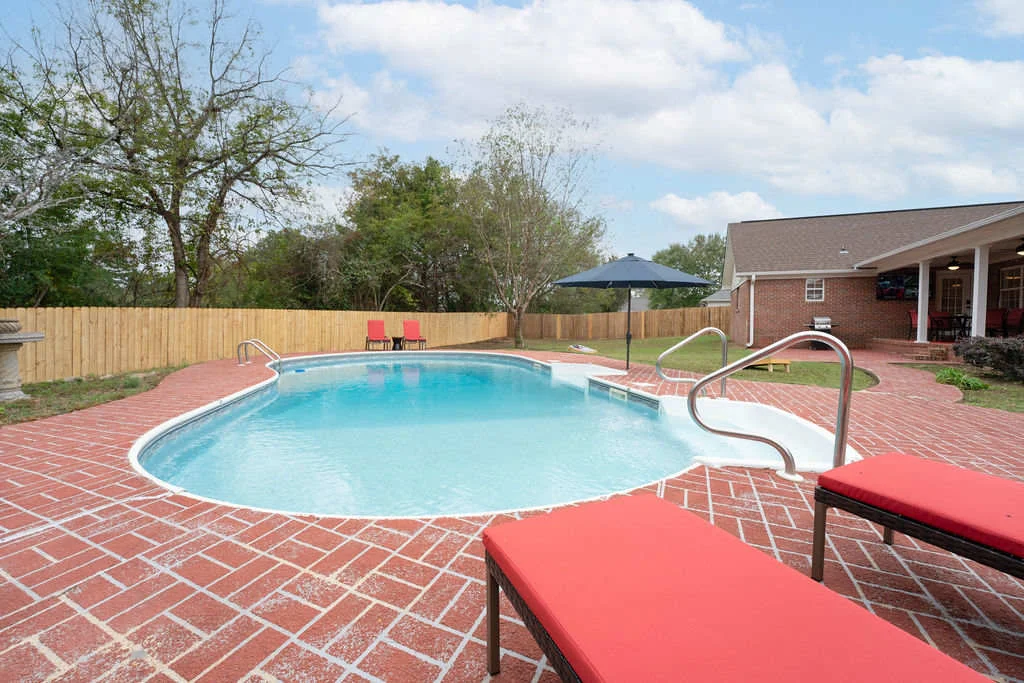
Private pool · Crimson Retreat
If you would rather own the property than run it, our full-service short-term and mid-term rental management comes with no hidden fees and no extensive contracts. Contact LuxeSleeps to talk through your property and your goals.
Written by Dave Smith, Owner & Operator at LuxeSleeps
Content powered by inkSTR.co